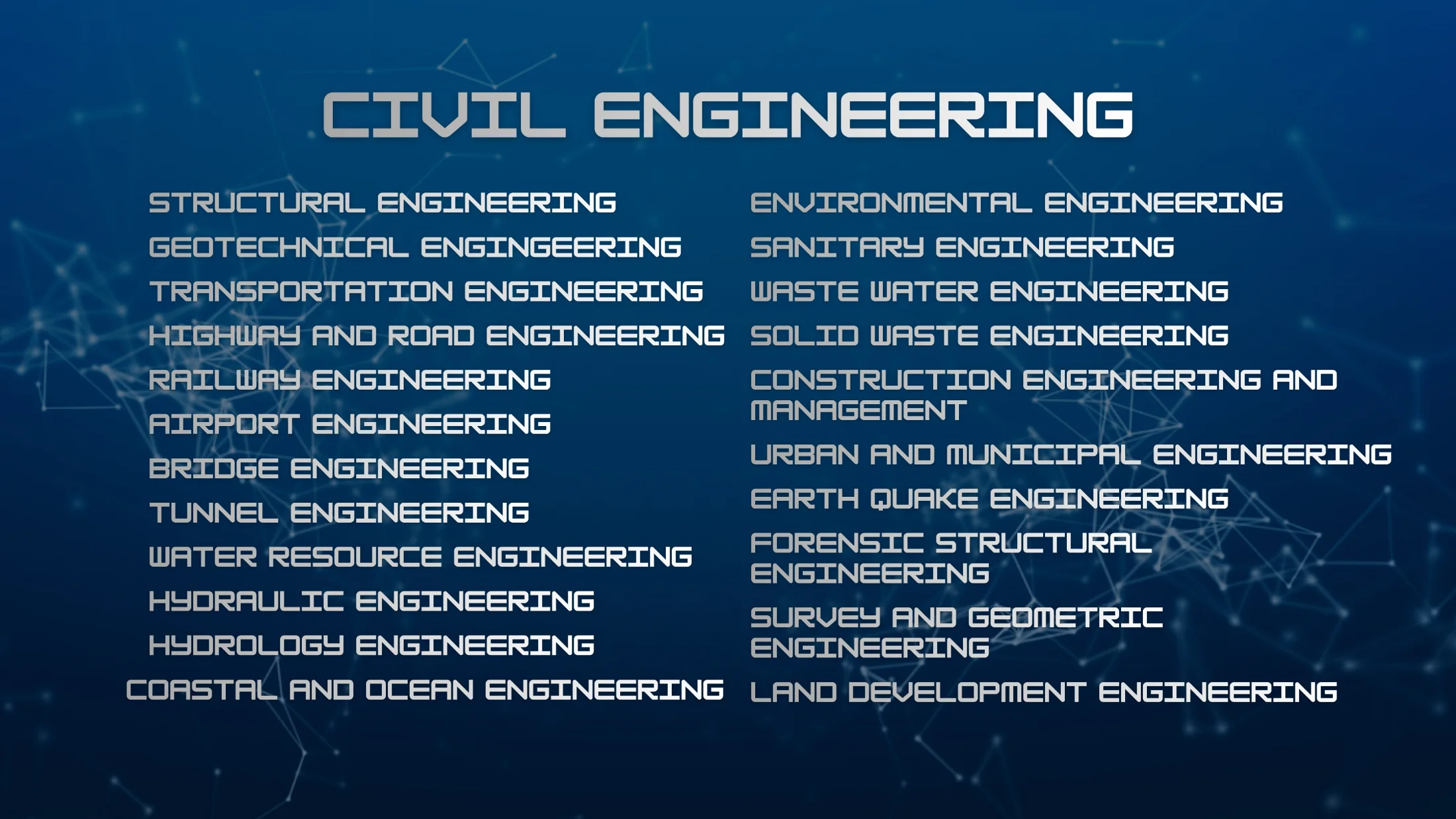
Civil Engineering is a foundational engineering discipline concerned with the planning, analysis, design, construction, operation, and maintenance of the built environment. It applies principles of mechanics, materials science, hydraulics, geotechnics, transportation systems, environmental science, and construction management to develop safe, durable, efficient, and sustainable infrastructure. The field supports the delivery of essential public and private works, including buildings, bridges, roads, railways, airports, tunnels, water supply systems, wastewater systems, coastal structures, and urban infrastructure.
Its major branches represent the broad technical scope of the discipline, covering structural stability, soil–foundation interaction, transportation network development, hydraulic and hydrologic systems, environmental protection, municipal services, construction execution, and infrastructure resilience.
Article details
Written by
Trapp
Reviewed by
EduFlare Admissions Team
Updated on
8 May 2026
Related articles
Keep reading
Explore more EduFlare guidance on scholarships, admissions, and studying abroad with confidence.
Civil Engineering focuses on the engineering of infrastructure and public works that support human activities and economic development. It involves the technical and managerial processes required to conceive, design, construct, supervise, operate, rehabilitate, and maintain physical systems such as buildings, highways, bridges, dams, pipelines, drainage systems, water treatment facilities, and urban service networks.
Students and professionals in this field typically study structural analysis, reinforced concrete design, steel design, geotechnical engineering, soil mechanics, fluid mechanics, hydrology, hydraulics, surveying, transportation engineering, highway engineering, environmental engineering, construction materials, project planning, and infrastructure management.
The central objective of Civil Engineering is to deliver infrastructure systems that are structurally sound, functionally efficient, environmentally responsible, economically feasible, and resilient under operational and extreme loading conditions.
Major Branches of Civil Engineering
Structural Engineering
Deals with the analysis and design of load-bearing structures such as buildings, bridges, towers, retaining systems, and industrial facilities. It ensures structural safety, serviceability, stability, and durability under dead loads, live loads, wind, seismic actions, and other imposed forces.
Geotechnical Engineering
Focuses on soil and rock behavior and their interaction with engineering structures. It includes foundation design, slope stability, retaining structures, ground improvement, embankments, excavation support, and geotechnical site investigation.
Transportation Engineering
Concerned with the planning, design, operation, and maintenance of transportation systems for the safe and efficient movement of people and goods. It includes traffic engineering, pavement systems, transport planning, mobility analysis, and logistics infrastructure.
Highway and Road Engineering
A specialized area of transportation engineering dealing with the geometric design, pavement design, construction, drainage, safety, and maintenance of roads and highways.
Railway Engineering
Focuses on the design, construction, operation, and maintenance of railway systems, including track alignment, ballast and subgrade systems, rail structures, stations, and rail transportation infrastructure.
Airport Engineering
Deals with the planning and design of airport infrastructure, including runways, taxiways, aprons, terminal interfaces, drainage systems, and pavement design to meet operational and safety standards.
Bridge Engineering
A specialized branch of structural engineering focused on the analysis, design, construction, inspection, and maintenance of bridge systems, considering load paths, material behavior, fatigue, vibration, and environmental exposure.
Tunnel Engineering
Involves the design and construction of underground passageways for transport, utilities, and water conveyance systems. It covers excavation methods, support systems, lining design, groundwater control, and tunnel safety.
Water Resources Engineering
Concerned with the assessment, development, management, and protection of water resources. It includes reservoirs, irrigation systems, drainage networks, flood control works, water distribution systems, and watershed management.
Hydraulic Engineering
Focuses on the behavior and controlled movement of water in engineered systems such as canals, spillways, dams, culverts, pipelines, and stormwater networks.
Hydrology Engineering
Deals with the occurrence, movement, distribution, and quality of water in the hydrologic cycle. It supports runoff estimation, flood forecasting, catchment analysis, groundwater studies, and water balance assessment.
Coastal and Ocean Engineering
Applies civil and hydraulic engineering principles to coastal zones and marine environments. It includes coastal protection, ports and harbors, offshore structures, shoreline management, sediment transport, and wave-structure interaction.
Environmental Engineering
Focuses on protecting public health and the environment through pollution control, water quality management, environmental impact mitigation, and sustainable infrastructure systems.
Sanitary Engineering
A branch of environmental and public health engineering dealing with water supply, sanitation systems, drainage, hygiene infrastructure, and health-oriented municipal services.
Wastewater Engineering
Covers the collection, conveyance, treatment, reuse, and disposal of wastewater. It includes sewer design, treatment plant processes, sludge handling, and effluent quality control.
Solid Waste Engineering
Concerned with the generation, storage, collection, transfer, treatment, recycling, and disposal of solid waste in a safe and environmentally sound manner.
Construction Engineering and Management
Focuses on the methods, technologies, planning, scheduling, costing, quality control, contract administration, equipment management, and site execution processes required to deliver infrastructure projects effectively.
Urban and Municipal Engineering
Deals with the planning, design, and management of infrastructure systems serving urban communities, including roads, drainage, water supply, sewerage, public utilities, and municipal service networks.
Earthquake Engineering
Focuses on the analysis and design of structures and infrastructure to resist seismic loading. It includes dynamic analysis, seismic detailing, base isolation, ductility design, and risk reduction strategies.
Forensic Structural Engineering
Involves the investigation of structural failures, damage mechanisms, material deterioration, and construction defects to determine technical causes and recommend corrective measures.
Surveying and Geomatics Engineering
Concerned with the measurement, mapping, positioning, and spatial representation of land and infrastructure. It includes land surveying, engineering surveying, GPS/GNSS, GIS, remote sensing, and geometric control.
Land Development Engineering
Focuses on the engineering preparation of land for residential, commercial, industrial, and institutional use. It includes site grading, drainage design, utility layout, road access planning, and development infrastructure integration.
Next step
Need help turning this research into your next move?
Talk to one of our experts for clear guidance on courses, admissions, funding strategy, and the right next step for your study abroad plan.
Practical EduFlare guidance on scholarships, admissions, and studying abroad with more confidence.